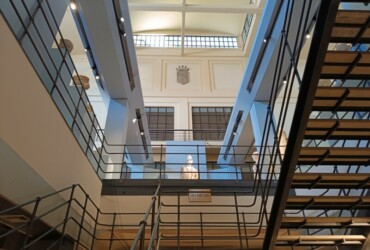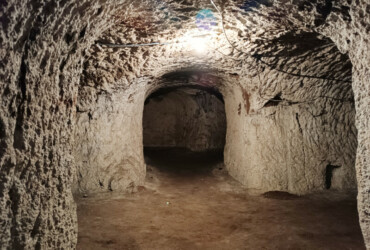
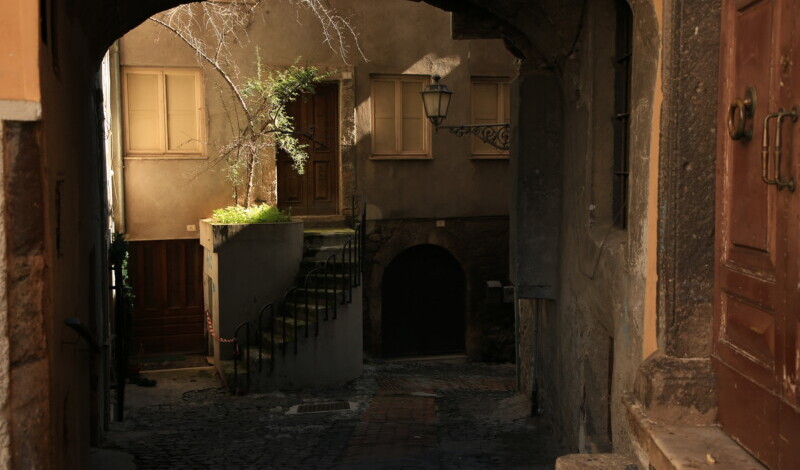
Anagni is one of those villages in Lazio that, for years, remained on the list of places to see without me being able to organize my visit. Known as the city of the Popes, Anagni is the city of origin of four popes and has long been the papal residence. In the historic city centre, there are several buildings linked to this, in particular the Palace of Boniface VIII, the site of memorable events of the European Middle Ages.
Anagni is known as “the city of the Popes”
This is because it was the birthplace of four popes (Innocent III, Alexander IV, Gregory IX and Boniface VIII) and because for a long time, the city was the residence and papal seat. In particular, Anagni is linked to the events of Pope Boniface VIII and the episode known as the “slap of Anagni” (sometimes also referred to as the “a’ tumpulata of Anagni”), an episode that took place on September 7, 1303, to the detriment of Pope Boniface VIII. In reality, it is not so much a slap in the face physically given, but rather a moral outrage.
Booking.com
Anagni: a bit of history
The ancient Anagnia, the capital of the Ernici, is located on a hill between the Ernici mountains and the Sacco Valley. Legend has it that Anagni is one of the “Saturnian cities”, the five cities of Lazio founded by the god Saturn (Anagni, Alatri, Arpino, Atina and Ferentino, the latter also called Antino). In 1160, during the battles between Pope Alexander III and Frederick Barbarossa, excommunication was pronounced in Anagni against the emperor and the antipope Victor IV. In the 13th century, Anagni fell under the rule of the Caetani and during this period it experienced a phase of extraordinary splendour.
The city was the scene of battles between the Colonna, the king of France Philip the Fair and Pope Boniface VIII, who was taken prisoner here (we spoke about the “slap of Anagni” above). Once the popes returned to Rome, Anagni suffered a decline. Coming to the present day, the sixties of the twentieth century there was an economic boom; with the passage of the highway there was the opening of numerous industries and the city transformed into an important commercial and industrial center.
What to see in Anagni
The town offers a good piece of history that visitors should know, as well as several buildings, churches and museums to discover. So let’s see together what to do and see during a trip to discover Anagni.
The Palace of the Popes or Palazzo Bonifacio VIII
The history of “Schiaffo” is linked to the Palace of Boniface VIII, built in Gothic style in the first decades of the 13th century. The building is bound to the figure of Pope Boniface VIII because it was purchased by his nephew Pietro II Caetani. It was originally owned by Gregory IX, another pope from Anagni, and later passed to his heirs. Right here, in the so-called “Sala delle Scacchiere”, what is historically better defined as the “Outrage” (or the “Slap of Anagni”) took place. The layout of the rooms allows you to admire the 13th-century frescoes: among these, the one that gives its name to the “Sala dei Colombi” stands out.
What is this “Schiaffo di Anagni”? Skipping a few premises, Philip the Fair had to avoid excommunication and decided to send William de Nogaret to Italy. The latter, thanks to the support of the Roman Colonna family (a bitter enemy of the Caetani, to whom Boniface VIII belonged), arrived in Anagni with an army of a thousand men led by Giacomo Colonna, known as Sciarra. According to tradition, Pope Boniface VIII took refuge on the second floor of the Caetani family palace, in the Chess Room (later called the Hall of the Slap), assisted only by Cardinal Nicolò Boccasini. The first to burst into the room was Sciarra Colonna himself, who famously slapped Pope Boniface VIII. Today the palace houses the museum of the same name, which can be visited in about an hour. The museum is open every day, from 9:30 to 19:00 in the summer and until 18:00 in the winter (from Monday to Friday it closes for lunch, from 13:00 to 15:00, while on Saturday and Sunday, it has continuous opening hours). The full ticket costs 6 euros per person and there is the possibility of guided tours. For all the details I refer you to the official website of the museum. In my opinion, the audio guide provided for the visit is useful and well-made, even if sometimes a little bit long in the explanation.
Booking.com
The Cathedral of Santa Maria and Piazza Innocenzo III
The Cathedral of Santa Maria, located in the suggestive Piazza Innocenzo III, dates back to the 12th and 13th centuries and is defined as the “artistic pride” of Anagni. This square is considered one of the most beautiful squares in Lazio, and here, in fact, there are other buildings from the late medieval period. The apses of the Cathedral dominate the large square with their grandeur and represent a masterpiece of Romanesque-Gothic architecture. The exterior of the Church is characterized by the “Loggia di Bonifacio Benedicente”, added in the fourteenth century. The bell tower, decorated with mullioned windows with mullioned windows, is a symbol of the city: it is detached and in position a few meters from the facade of the cathedral in Romanesque-Campanian style (with Lombard influences), typical of southern Lazio. The interior of the church, although retouched and renovated several times, recalls the ancient appearance of the cathedral with its Gothic vaults, columns (which separate the three longitudinal naves), the Romanesque ciborium, and the crypt. The entrance to the cathedral is not on the “first square” where you arrive and find the building, but rather “on the back”. You have to go up some stairs, following the dedicated signs, and you will arrive in a small square where we find the facade and the entrance.
Next to the entrance to the cathedral there is the Museum of the Cathedral of Anagni. You can visit various rooms, on two floors, and the crypt; the latter has timed lighting, to safeguard and preserve the frescoes, so you should consider the possibility of waiting to see it illuminated. The museum is open every day:
From November to March from 09.00 to 13.00 and from 15.00 to 18.00; from April to October from 13:00 and from 15:00 to 19:00. The website indicates the need to book in advance to visit the museum.
The Town Hall
Also from the medieval era, the Town Hall is a noteworthy building. Built between 1159 and 1160 based on a design by Jacopo da Iseo (but later renovated with lines that recall the Gothic style), the building has a series of arches that support what is called the “Sala della Ragione”; this portico also allowed access to the Piazza Comunale, where the city market was held.
The Barnekow House
Finally, the Barnekow House deserves particular attention, a building long considered to be from the 13th century, but most likely Renaissance. The house, which represents an important example of Anagnina civil architecture, and is characterized by an external staircase and round arches, which belonged to the Gigli family for a long time (and in which, according to legend, even Dante Alighieri stayed), takes its name from that of the noble Swedish painter and officer of the Hussars Alberto Barkenow, who bought it and lived there in the second half of the nineteenth century, making it the golden cradle of complete solitude. This is located in Via Vittorio Emanuele, the main axis that cuts through the entire historic centre at the height of the Church of Sant’Andrea.
More to discover in Anagni
Despite the deep wounds of history, Anagni is certainly a destination that allows you to discover and learn about many monuments from the medieval era, as well as attend noteworthy events and shows. The historic centre, characterized mainly by glimpses and architecture from the 13th and 18th centuries, is certainly full of glimpses and historical buildings to discover. In addition to those we have spoken about so far, we also find Palazzo Trajetto, the “Casa Pendente” (a tower-house near the Town Hall), the Church of Sant’Andrea (which houses the important “Triptych of the Holy Savior” – from the 13th century), the churches of Santa Balbina and Sant’Agostino (dating back to the 13th century but subsequently renovated), and the Church of San Pietro in Vineis (just outside the town and full of frescoes of Franciscan inspiration).