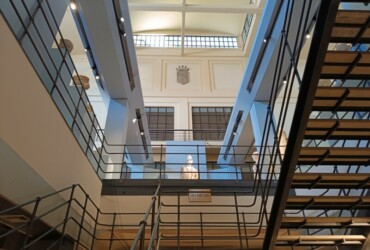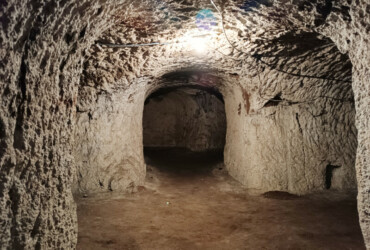
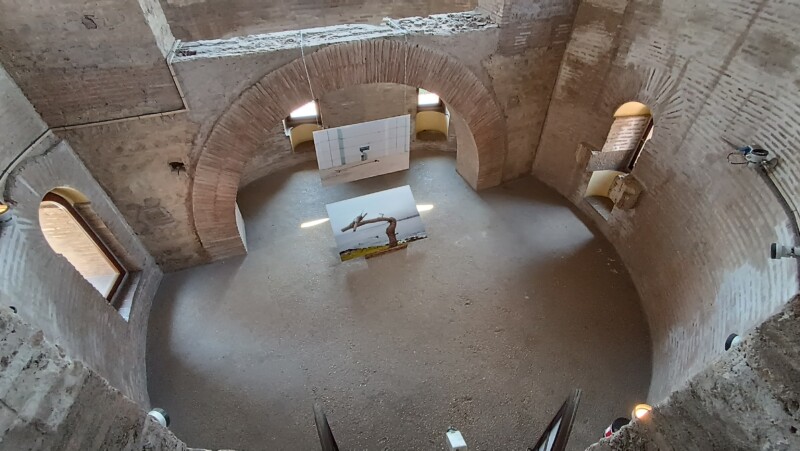
The Muso delle mura is located inside Porta San Sebastiano, one of the largest and best preserved of the Aurelian Walls. The museum is divided into three sections – ancient, medieval and modern – through which it traces the history of the city’s fortifications, from the royal and republican age to Aurelian in the 3rd century AD.
Museum of the Walls: Porta San Sebastiano
Porta San Sebastiano, as we have already seen, is one of the largest and best preserved of the Aurelian Walls; its real name was Porta Appia, from the Via Appia (the important road artery onto which it opened). Over time the name changed: in the Middle Ages it was corrupted into Daccia and Dazza; in the end, the name of Porta S. Sebastiano prevailed, in memory of the Christian martyr buried in the basilica on the Via Appia just outside the walls. As for the architecture of the gate, this is due to the numerous transformations it has undergone over time; These changes can be divided into five periods:
First period – Refers to the original shape of the gate with two twin arches, the facade covered in travertine and two semicircular towers on the sides. Inside the towers were stairs to access the upper floors: over time these were narrowed and then walled up. Remains of the structures of this first phase were seen by the scholar Richmond, before 1930, inside the later walls.
Second period – Honorius took care of the first transformations, together with a general reconstruction of the walls. The towers were incorporated into new, higher and circular towers; a counter-door was added and the internal courtyards housed the offices and customs guards to control goods.
Third period – The bastions surrounding the towers date back to this period, leaving only one floor outside, and the passage from two entrance arches into a single one as we see today. The masonry around the arch and the first floor of the bastions were covered with blocks of reused marble. On the keystone of the internal arch is engraved a cross with an inscription in Greek that says: “By the grace of God to the saints Conon and George”. On the first floor of the attic, used as a control room for the portcullis to close the door, there are still travertine brackets that support the ropes to move the grate.
Fourth period – The masonry vaults that divided the towers into three floors were eliminated. The upper part of the quadrangular bastion of the west tower was made a rosoliore during the restorations carried out between the 6th and 9th centuries.
Fifth period – In the last construction phase, the towers and the attic above the entrance were raised by one floor, giving the door the imposing appearance that can still be admired today.
Since the Middle Ages, the gate was the scene of clashes such as the one that took place in 1327 between the Roman factions of the Guelphs and the Ghibellines. We also know that there were restoration works between 1749 and 1752, under the pontificate of Benedict XIV; furthermore, in 1783 consolidation works were necessary, in particular of the north tower.
Museo delle mura: the rooms of the museum
Room I – Educational room
It is located inside the western tower. On the travertine floor, there is a three-color mosaic (1940-1943) that reproduces two deer and a tiger in ambush with surrounding vegetation. In this room, there is a screen for video projections and it’s preserved the travertine floor.
Room II
The room, located above the entrance arch of Porta San Sebastiano, connects the two large towers of the gate. In this room, we find educational panels dedicated partially to the pomerium and the oldest city walls of ancient Rome, from the 6th and 4th centuries BC. Here we also find the Aurelian Walls history, the historical-political events that determined their construction, the building technique and other themes always linked to the walls and their evolution. Along the walls, moreover, we find plaster casts of the crosses engraved above the arch of some doors, and decorations with palmettes and rays, all dating back to the beginning of the 5th century AD.
Room III
It is located in the east tower and houses four models of the walls and the circuit of the royal, republican and Aurelian fortifications.
Room IV
This room, next to the west tower, is dedicated to the architectural events of Porta San Sebastiano from the 3rd to the 5th century AD, following which the gate took on the monumental appearance that still characterizes it today. Also in this room, there is a brief description of the other gates of the city walls.
Room V
This Room is located in the west tower; here are some explanatory panels and a reconstructive model – which reproduces the stretch of walls between Porta Asinaria and the Castrense Amphitheater.
Panoramic terrace and walkway
The panoramic terrace of the central body of the gate, located between the two crenellated towers, offers a suggestive view from Via Appia Antica to the Castelli Romani. The Museum of the Walls is located inside Porta San Sebastiano, one of the largest and best preserved of the Aurelian Walls. The museum is divided into three sections – ancient, medieval and modern – through which it traces the history of the city’s fortifications, from the royal and republican age to Aurelian in the 3rd century AD.
Museo delle mura: useful information
The museum address is via di San Sebastiano 18, near Porta San Sebastiano or Porta Appia, in Rome and is managed by Musei in Comune.