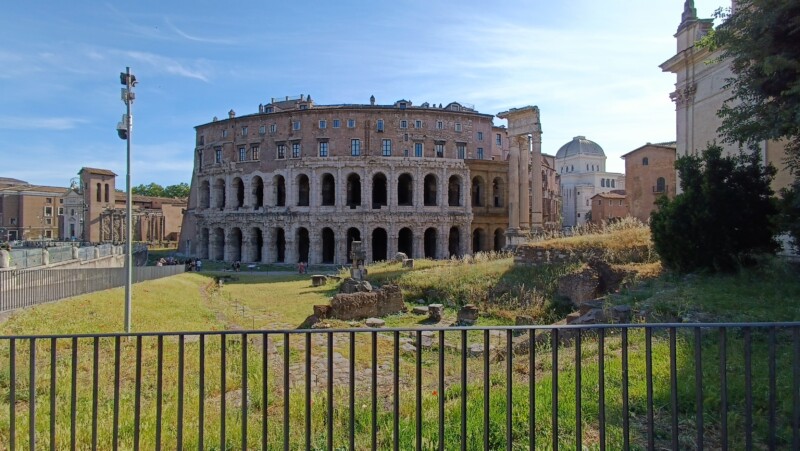
The Teatro di Marcello is a theatre in ancient Rome built by the order of Caesar in the southern part of the Campus Martius, between the Tiber River and the Capitoline Hill. The building is still partially preserved today. In the same area, from 179 BC, was the Theatrum et proscenium ad Apollinis, connected to the temple of Apollo.Given its elevated position near the river, at a point where it was easy to ford, it was transformed into a fortress owned by the Pierleoni and the Fabii.
Teatro di Marcello: the history
The Teatro di Marcello was a huge construction with a diameter of 130 m., in which the Roman-style
 theatre was built in its complete form. Julius Caesar, who began construction work, expropriated the area and demolished the existing buildings, including the Temple of Piety, and was a lot criticized for this. The project was taken up by Augustus, who made further expropriations to expand the surface area and build a larger building. Perhaps by 17 BC the construction of the Teatro di Marcello was
 completed: that year it was used for secular games. In 13 or 11 BC it was given the name of Marcello, the emperor’s nephew. Later on, Vespasian and Alexander Severus carried out restorations, and in the 4th century it seems that the theater was still in use. Then, it underwent some transformations.
In the 16th century, Baldassarre Peruzzi built the palace that we can still admire today, commissioned by the Savelli family, and which was then purchased by the Orsini family. The lower part, corresponding to the Roman structures, was purchased in the 1930s by the Municipality of Rome: this part of the building was excavated and restored after the conclusion of some works to liberate the area.
Teatro di Marcello: the building’s structure
The cavea had a semicircular shape and was on substructures:
 the walls, in blocks of tuff, in opus reticulatum and in brick, formed the structure on which the white marble steps rested. The curvilinear walls divided three areas:
• the first, corresponding to the external ambulatory;
• the second reserved for the arches with different functions every six, which guaranteed access to the various levels;
• the third consisting of unlit rooms, many of which were probably warehouses;
On the outside, there was the curved façade in travertine with a triple order: Today we may admire mainly the two lower orders. The cavea, not excavated, radially divided into six areas, probably had a capacity of 15,000 seats, 20,000 in case of need. The stage had a modest depth and a probably rectilinear façade, it was flanked by two triple-nave halls or parascenia and completed at the back by a large apse erected against possible flooding by the Tiber. The theatre was covered with a velarium. Finally, some sources report the presence of 36 bronze vases to improve the acoustics.
Teatro di Marcello: the visit
The Entrance to the area is free, during the opening hours. The interiors are closed to the visitors, but the external walk runs alongside the theater and leads to the Portico d’Ottavia located in the Jewish Ghetto area; visitors can also take the same route “in reverse”, from the Portico to the Teatro Marcello.
Nearby there are many places of interest: the Capitoline Museums, the Vittoriano, the Basilica of Santa Maria in Ara Coeli.
Close to the basilica there is the Insula dell’Ara Coeli (which can be visited by taking part in guided tours). Furthermore, for those who want to take a slightly longer walk, not far away we also find the Imperial Forums and the Colosseum.